

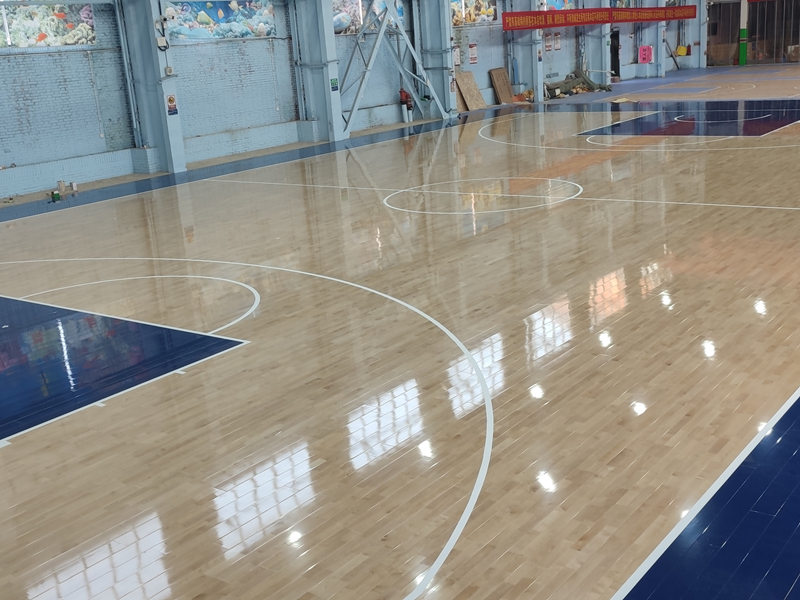
Every element of how a basketball moves and behaves on an indoor court is shaped by the properties of the playing surface, and indoor basketball court wooden flooring is specifically tuned to create the most predictable, consistent ball dynamics possible. When a player dribbles a basketball on a well-maintained wooden floor, the ball bounces back with a consistent, even energy that allows players to develop a reliable feel for how much force they need to apply to control the ball at different speeds. This consistent bounce comes from the combination of the firm, stable top wood layer and the slightly yielding subfloor beneath it—harder surfaces can make the ball bounce too high and too fast, while overly soft surfaces absorb too much energy and make dribbling feel sluggish and unpredictable. A properly constructed wooden floor delivers a bounce that matches the official specifications for competitive basketball, so players can develop their dribbling, passing, and shooting muscle memory in a way that translates perfectly across different high-quality courts.
The way a basketball rolls across indoor basketball court wooden flooring also directly impacts gameplay, especially during fast breaks and close-quarters play near the basket. A perfectly flat, uniformly finished wooden surface eliminates the tiny bumps, uneven spots, and subtle irregularities that can make a basketball veer off course unexpectedly. This means that when a player makes a bounce pass to a teammate, they can trust that the ball will travel exactly where they aim it, without bouncing off a hidden imperfection in the floor and taking their opponent by surprise. This predictability allows teams to run complex offensive sets with confidence, knowing that every pass and every dribble will behave exactly the way they practiced it, rather than being disrupted by inconsistencies in the playing surface.
Even the sound of a basketball bouncing on indoor basketball court wooden flooring contributes to the rhythm of the game, creating a consistent auditory cue that players use to judge their own speed and timing. The clear, resonant thud of a ball hitting polished wood is different from the dull, muted sound of a ball hitting a synthetic surface, and over years of playing, basketball players develop an intuitive sense for this sound that helps them stay aware of the flow of the game even when their attention is focused elsewhere. This combination of consistent bounce, predictable roll, and familiar sensory feedback makes wooden flooring the ideal surface for developing high-level basketball skills, as it creates an environment where every movement of the ball feels natural, reliable, and exactly what players expect from a high-quality competitive court.
Leave a Reply