

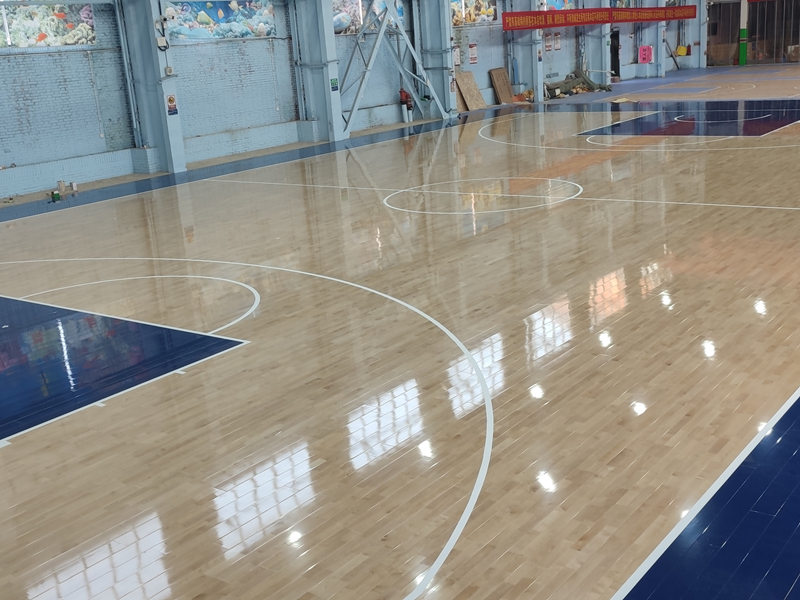
When it comes to choosing the wood for a basketball court, two species dominate the market: hard maple and red oak. Both are excellent choices, but they have different characteristics that make them better suited for different applications. In this article, we will compare hard maple and red oak in detail, helping you make an informed decision for your basketball court project.
Hard Maple: The Professional Choice
Hard maple, specifically sugar maple (Acer saccharum), is the gold standard for basketball court flooring. It is the wood specified by the NBA, NCAA, and FIBA for their official courts. If you have ever watched a professional basketball game on television, you have seen a hard maple floor.
Hard maple is incredibly dense, with a Janka hardness rating of about 1,450 pounds-force. This means it is extremely resistant to dents, scratches, and wear. The tight, uniform grain of hard maple also provides a consistent playing surface, which is essential for professional-level play.
The color of hard maple is a light, creamy blonde that is both beautiful and classic. It provides excellent contrast with court lines and team logos, making it easy to see markings during gameplay.
One of the key advantages of hard maple is its superior ball bounce. The density and stiffness of the wood provide a consistent, predictable bounce that professional players rely on. The shock absorption is also excellent, protecting players' joints during the intense physical demands of the game.
However, hard maple comes with a higher price tag. It is more expensive than red oak, both in terms of the raw material and the installation cost. For professional or collegiate courts, this cost is justified by the performance benefits. For recreational facilities with limited budgets, hard maple may not be feasible.
Red Oak: The Budget-Friendly Alternative
Red oak (Quercus rubra) is the most popular alternative to hard maple for basketball court flooring. It is significantly less expensive, making it an attractive option for school gyms, community centers, and recreational facilities.
Red oak has a Janka hardness rating of about 1,290 pounds-force, which is still quite hard but not as dense as hard maple. The grain of red oak is more open and pronounced, giving it a distinctive look that many people find attractive. The color ranges from light pinkish-brown to a deeper reddish-brown, depending on the specific board.
In terms of performance, red oak is very good, though not quite at the level of hard maple. The ball bounce is slightly less consistent, and the shock absorption is marginally lower. For casual play and recreational use, these differences are barely noticeable. However, for competitive play at a high level, players may notice the difference.
Red oak is also slightly less durable than hard maple. It is more prone to denting and scratching, especially in high-traffic areas like the key and the free-throw line. With proper maintenance, however, a red oak court can still last for many years.
Cost Comparison
The cost difference between hard maple and red oak is significant. As of recent market prices, hard maple flooring can cost between 8 to 15 dollars per square foot for materials alone, while red oak typically ranges from 4 to 8 dollars per square foot. When you factor in installation, the total cost for a hard maple court can be two to three times that of a red oak court.
For a standard NBA-sized court (about 4,700 square feet), a hard maple floor can cost 50,000 to 100,000 dollars or more, while a red oak floor might cost 20,000 to 40,000 dollars.
Which Should You Choose?
The answer depends on your specific needs and budget. If you are building a court for professional or collegiate play, or if you want the absolute best performance and aesthetics, hard maple is the clear choice. It is what the pros use, and it delivers professional-level results.
If you are building a court for a school, community center, or recreational facility, red oak is an excellent choice that will provide good performance at a fraction of the cost. With proper maintenance, a red oak court can serve your facility well for many years.
Some facilities opt for a hybrid approach, using hard maple in the most critical areas (like the key and the center court) and red oak in the less trafficked areas. This can provide a good balance between performance and cost.
In conclusion, both hard maple and red oak are excellent choices for basketball court flooring. Hard maple is the superior performer and the professional standard, while red oak offers great value for recreational and budget-conscious projects. Whichever you choose, you will have a beautiful, functional court that players will love.
Leave a Reply