

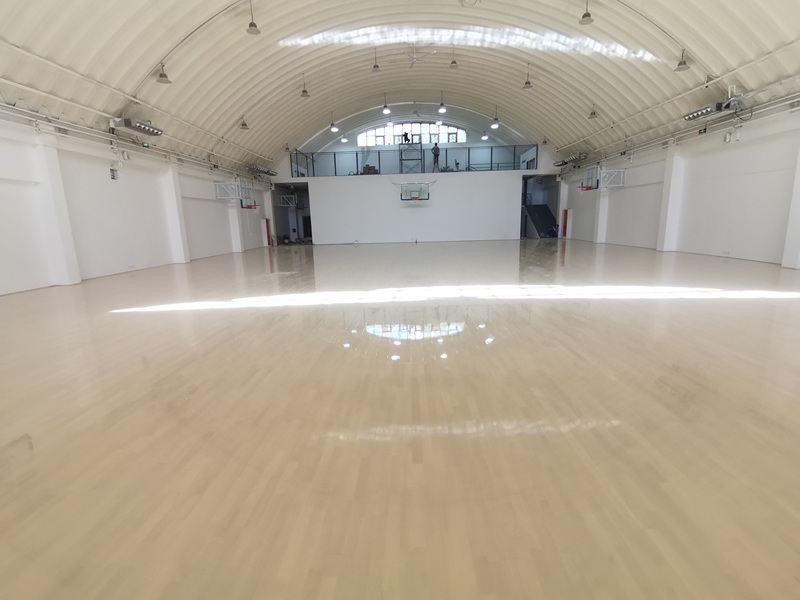
Volleyball is a sport of power and precision. Players jump, dive, spike, and slide across the court with incredible athleticism. The demands placed on the flooring are unique, and indoor sports wooden flooring has proven to be the ideal surface for volleyball at every competitive level.
The most critical requirement for a volleyball court floor is rigidity. Volleyball is played on a hard surface, and the ball must bounce consistently and predictably. Unlike basketball, where some energy absorption is acceptable, volleyball floors must return nearly all of the ball's energy. The ball rebound rate for volleyball should be between 90 and 95 percent. This requires a very stiff floor system with minimal elastic padding under the wood.
The flatness requirement for volleyball is even more stringent than for badminton. The court must be level to within 8 to 15 years before it needs to be replaced entirely. Over a 30-year period, you would need to install it two to three times, plus pay for ongoing maintenance. The total cost over 30 years could easily exceed 150 to 250 dollars per square meter.
An indoor sports wooden floor, properly maintained, lasts 30 to 50 years. During that time, it may need to be recoated every two to three years, which costs a fraction of the original installation price. A deep sanding and refinishing every 10 to 15 years is also relatively affordable. The total cost of ownership over 30 years is often 100 to 180 dollars per square meter, which is comparable to or lower than the alternatives.
Beyond the direct costs, there are indirect costs to consider. Injury rates on hard, non-wood surfaces are significantly higher. Each injury represents medical costs, lost playing time, and potential liability. A floor that reduces injuries by even a small percentage can save thousands of dollars per year in a busy facility.
There is also the intangible cost of player experience. Athletes perform better on wood. They are more confident, more comfortable, and less likely to be distracted by a poor playing surface. For a facility that hosts competitions or charges membership fees, this translates directly into revenue. A facility with a premium wood floor can justify higher fees and attract more users.
Finally, there is the resale value. A well-maintained sports wood floor adds value to the building. A facility with a worn-out synthetic surface does not. When an athlete's body. This directly reduces the risk of stress fractures, joint injuries, and chronic conditions. The shock absorption values are carefully calibrated for each sport. For basketball, a higher level of shock absorption is appropriate. For volleyball, a lower level is needed to maintain ball behavior. In both cases, the floor meets or exceeds safety standards.
Slip resistance is the second critical safety feature. A slippery floor is one of the most common causes of sports injuries. Ankle sprains, knee ligament tears, and muscle pulls often occur when an athlete's foot slides unexpectedly. Indoor sports wooden flooring is finished with specialized anti-slip coatings that maintain a consistent coefficient of friction, even when the surface is damp with sweat. The friction level is carefully balanced: high enough to prevent slipping, but not so high that it causes excessive torque on the knee joint.
The third safety feature is surface consistency. A good sports wood floor is perfectly flat and uniform. There are no bumps, dips, or soft spots that could cause an athlete to lose balance. This consistency is achieved through precise installation and regular maintenance. A well-maintained wood floor provides the same playing experience from one end of the court to the other.
The fourth safety feature is the absence of harmful chemicals. Modern water-based finishes are non-toxic and do not off-gas harmful fumes. This protects both athletes and facility staff from respiratory irritation and other health effects. Older solvent-based finishes, which were common decades ago, are no longer used in professional.
The fifth safety feature is fire resistance. While wood is combustible, modern sports wood floors are treated with fire-ret of moisture-related problems.
Today, indoor sports wooden flooring is a highly engineered product. Computer-aided design, precision manufacturing, and advanced finish chemistry have produced floors that meet exacting performance standards. Ball rebound, shock absorption, slip resistance, and flatness are all measured and certified. The modern sports wood floor is a far cry from the simple gymnasium plank of 1891, but its purpose is the same: to give athletes the best possible surface on which to compete.
The future of sports wood flooring will likely bring even more innovation. Smarter materials, better finishes, and more sustainable manufacturing processes are all on the horizon. But the core principle will remain unchanged: wood is the best material for indoor sports, and it will continue to be for generations to come.
Leave a Reply