

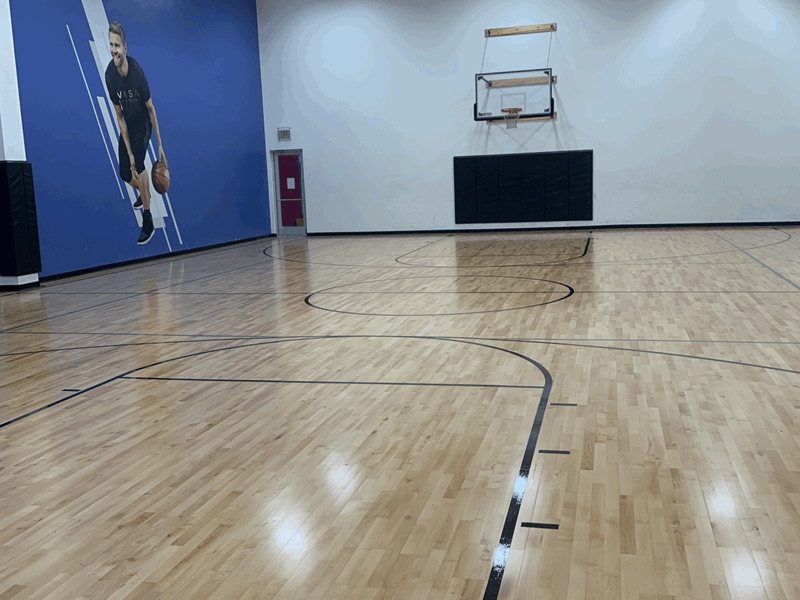
What most people see when they walk into an indoor basketball gym is the smooth, finished top layer of basketball court wood flooring, but the real magic of how the surface performs lives in the multi-layer structure hidden beneath the visible planks. This substructure is not just a simple flat base to hold the wood up—it is a carefully engineered system designed to balance shock absorption, stability, and consistent bounce across every inch of the court. Without this well-built underlying system, even the highest quality top wood planks would not perform the way a proper basketball surface needs to.
At the very bottom of the system, above the concrete base of the gym, there is a layer of resilient pads or rubber cushions spaced evenly across the floor. These small, supportive elements are the first line of shock absorption. When a player jumps and lands, these pads compress slightly to take the brunt of that impact force, before that force can travel up into the player’s joints. The pads are carefully calibrated to compress a very specific amount, so they never give too much and make the floor feel soft, but they give just enough to take the harsh edge off every landing. This layer also creates a small air gap between the wood floor and the concrete, which helps prevent moisture from seeping up into the planks from the ground below.
Above those resilient pads, a network of wooden sleepers is laid out in a crisscross pattern, creating a stable, level framework that supports the entire playing surface. These sleepers are secured in a way that allows for tiny amounts of movement, so the whole floor can flex slightly as players run and jump across it, without any one spot taking too much stress. This distributed flexibility is what makes the floor feel alive under players’ feet, instead of feeling like a hard, dead slab attached directly to the concrete. The sleepers are spaced at precise intervals, so there are no weak spots in the structure that could sag or warp over years of heavy use.
On top of the sleepers, a layer of plywood or strong, stable paneling is laid down to create a uniform base for the final playing surface. This layer adds extra rigidity across the entire court, so no single plank can shift or move independently of the rest of the floor. It also helps distribute impact forces across a much wider area, so the force of a single player’s landing is spread out over dozens of planks instead of being concentrated on one small spot. This is a key part of what creates that perfectly consistent bounce across the whole court, because there are no soft spots or hard spots where the structure is weaker.
Finally, the top layer of finished hardwood planks is installed over this entire stable base. These planks are secured in a way that leaves tiny, controlled gaps between each one, to give the wood room to expand and contract as the temperature and humidity in the gym change throughout the year. This entire multi-layer system works together in perfect harmony, and every single part of it plays a role in making the floor safe, responsive, and durable. Most players never even see this hidden structure, but every time they make a perfect cut, land a safe jump, or dribble with total confidence, they are benefiting from the careful engineering that went into building the layers under their feet.
Leave a Reply