

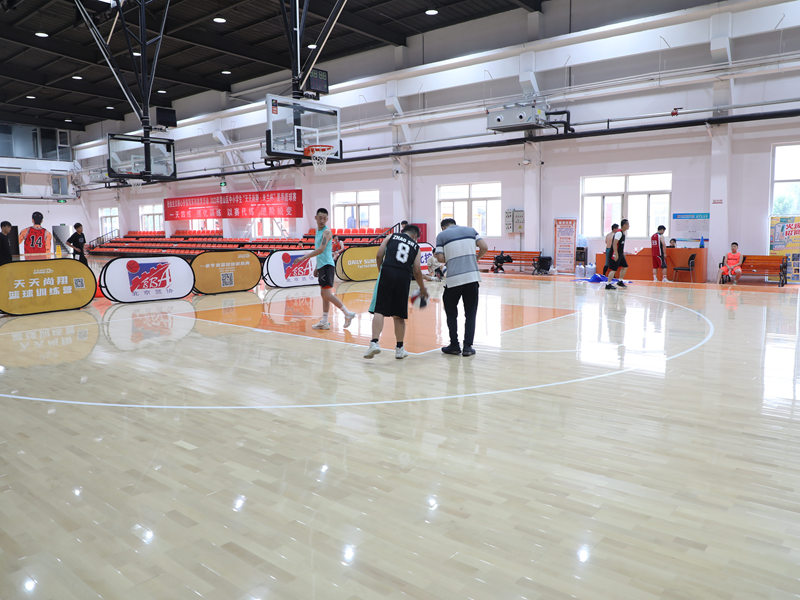
Understanding the technology and materials behind portable indoor sports wooden flooring helps you appreciate why these systems perform so well despite being designed for mobility. Every component, from the surface wood to the connection system, is engineered for a specific purpose.
The Surface Layer: Hardwood Selection
The top layer is almost always a dense hardwood. Maple is the most common choice for basketball and multi-sport courts because of its tight grain, high Janka hardness rating, and consistent ball response. The Janka hardness of sugar maple is around 1450 pounds-force, which means it resists dents and wear exceptionally well.
Oak is sometimes used for its attractive grain pattern, though it is slightly less dense than maple. Birch offers a middle ground between the two. Regardless of species, the wood is kiln-dried to a moisture content of six to nine percent, which minimizes expansion and contraction after installation.
The Multi-Layer Construction
Beneath the hardwood surface, most portable panels use a plywood core. This core provides dimensional stability, preventing the panel from warping or cupping. The plywood is typically made from birch or poplar, both of which are strong and lightweight.
Between the hardwood and the plywood, some systems include a thin layer of foam or rubber for additional shock absorption. This layer is critical for athlete safety, reducing the impact forces transmitted through the floor to the joints.
The Connection System: Engineering the Lock
The connection system is what makes a floor portable. The most common design uses a tongue-and-groove mechanism on the long edges and a puzzle-piece or interlocking clip system on the short edges. The tongue fits into a precisely machined groove, and a locking clip or pin secures the joint.
The tolerance on these connections is extremely tight, usually within a fraction of a millimeter. This precision ensures that panels sit flush with each other, creating a seamless playing surface. At the same time, the connections are designed to be released with simple tools, allowing quick disassembly.
The Subframe: The Hidden Foundation
The subframe is often overlooked but is critical to performance. It must be rigid enough to prevent flexing under load but light enough to be transported. Steel subframes are the most common for heavy-duty applications. Aluminum subframes are lighter and easier to move but may flex slightly under heavy impact.
Most subframes include adjustable feet or jacks that allow fine-tuning of the floor's level. This adjustability is essential because no building floor is perfectly level, and even small deviations can affect play.
Finish Technology
The finish on a sports floor is not decorative, it is functional. It must provide the right amount of friction, resist wear, and be easy to clean. Most portable floors use a water-based polyurethane finish applied in multiple thin coats. This finish creates a matte to semi-gloss surface that meets the friction requirements of international sports standards.
Adhesive-Free Design
Unlike permanent floors, portable systems use no adhesive. Every connection is mechanical. This is what allows the floor to be disassembled and reassembled without damage. The absence of adhesive also means there is no off-gassing, making portable floors a healthier choice for indoor environments.
Leave a Reply