

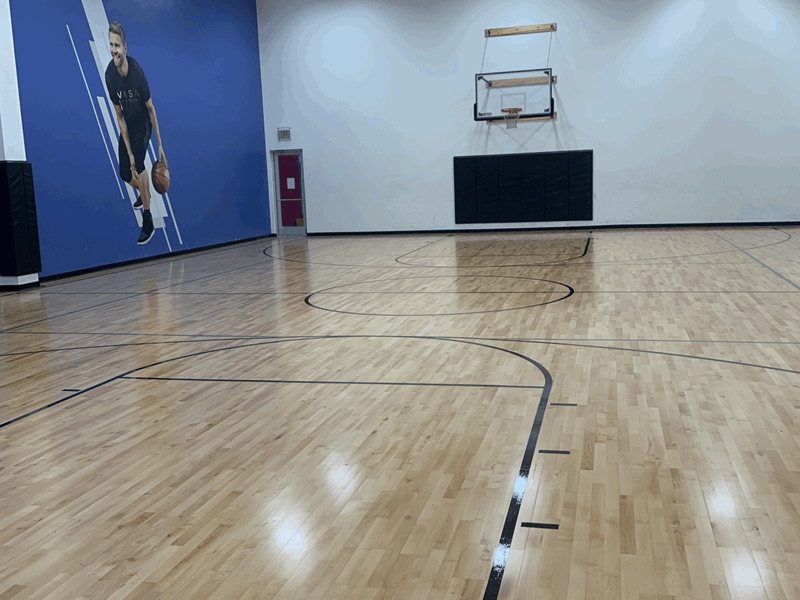
Even with the most careful daily maintenance, after years of constant use, indoor basketball court wood flooring will eventually show signs of wear: the top protective finish will become dull, scuffed, and the surface friction will start to become inconsistent across different areas of the court. When this happens, the refinishing process is the perfect way to bring the floor back to like-new performance, without having to replace the entire wood surface. The process starts by completely clearing the court, removing all basketball hoops, benches, and any other equipment from the playing area. The first step of the work is a heavy sanding, using a large industrial floor sander that removes the old worn finish, along with the top tiny layer of the wood itself. This sanding also removes all deep scuff marks, old stains, and minor uneven spots that have built up over years of play.
After the first heavy sanding pass, the team uses smaller edge sanders to reach the areas along the court boundaries, under the hoops, and in the corners that the large industrial sander cannot reach. Then, they make several more passes over the entire floor with progressively finer sandpaper, smoothing out all the scratch marks left by the coarse initial sanding. Once the entire surface is perfectly smooth, all the dust from the sanding process is completely vacuumed up, and the floor is wiped down with a dry microfiber cloth to remove every last particle of fine wood dust. At this stage, the natural raw wood grain is fully exposed, and the entire court has a consistent, uniform appearance that looks brand new.
Next, the first coat of specialized sports floor finish is applied. This finish is designed specifically for basketball courts, to create a tough, non-slip surface that can stand up to thousands of hours of foot traffic. The team applies the finish evenly across the entire court, working in sections to make sure there are no streaks, runs, or thick spots that would create uneven friction. After the first coat dries completely, a light intermediate sanding is done to smooth out any tiny imperfections in the finish, before the second and sometimes third coat of finish is applied. Once the final coat is fully cured, which usually takes several days, the court lines can be repainted. The end result is a floor that performs exactly like a brand new installation, with perfect friction, smoothness, and consistent ball rebound, at a small fraction of the cost of replacing the entire floor.
Leave a Reply