

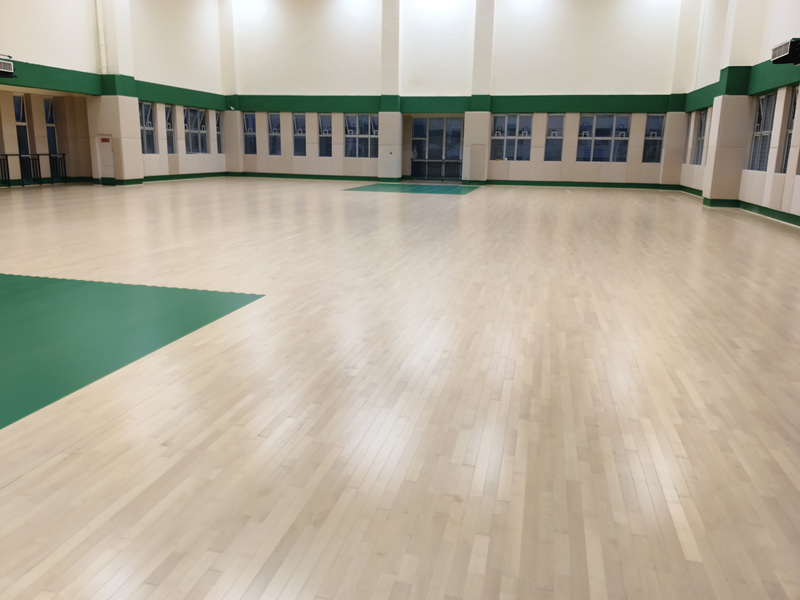
The modern basketball court wooden floor that we see in every top-level competitive arena today is not a static design: it has evolved dramatically over the past 70 years, shaped by decades of feedback from professional players, coaches, and facility managers, and refined to address every flaw and limitation of earlier generations of wooden court surfaces. In the early days of organized basketball, most courts were simple, basic wooden floors that were originally built for other purposes, like school auditoriums or community halls. These early floors were often made from soft, low-quality wood, nailed directly to rough wooden joists with no specialized subfloor or moisture barrier. They had extremely inconsistent performance: some sections of the floor were soft and springy, while other sections were rock hard, and the ball bounced completely differently in different parts of the court. Players had no shock absorption at all, and injuries were extremely common, while the floors would warp and gap dramatically with every change in the weather. It was not until the 1940s that the first standardized basketball court wooden floor design was introduced, using a dense, hard hardwood species that delivered far more consistent ball bounce than the soft woods that had been used before. This new design used a simple nailed-down installation, and it quickly became the standard across top professional leagues, setting a new baseline for court performance. Over the following decades, designers began to experiment with adding specialized resilient pads beneath the wood planks, which introduced controlled shock absorption to the floor for the first time, reducing injury rates dramatically. These early padded systems were a huge breakthrough, but they still had issues with moisture damage, and they would often develop soft spots in areas with heavy foot traffic. In the 1980s and 1990s, the introduction of advanced moisture barrier materials and precision-engineered multi-layer subfloor systems solved most of these stability issues, making basketball court wooden floors far more resistant to warping and moisture damage, and extending their total lifespan to 20 years or more. The 2000s brought new advances in finish technology, with ultraviolet-cured coatings that were far more scratch-resistant and long-lasting than the old oil-based finishes that had been used for decades. Today, the latest generation of basketball court wooden floor systems uses computer-calibrated support structures that can be fine-tuned to adjust the exact level of springiness in different sections of the court, delivering a level of performance consistency that would have been unimaginable to the players of the 1940s. This 70-year evolution has been driven entirely by the goal of making the game safer, fairer, and more enjoyable for every player, from professional athletes competing for a championship to casual kids playing pickup games at their local community center.
The Evolution of Basketball Court Wooden Floor Design Over 70 Years
Leave a Reply