

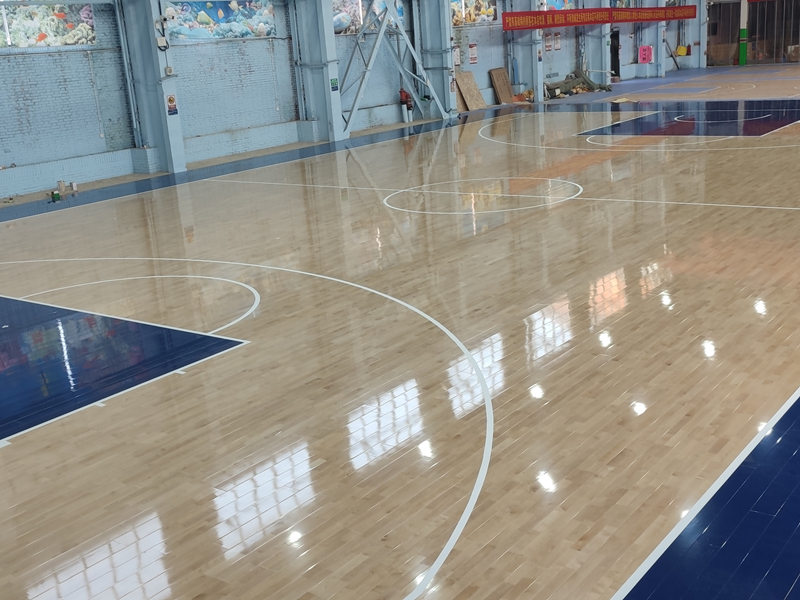
Anti-slip performance is the core functional index of indoor sports wooden flooring, which is directly related to the movement safety of athletes. The traditional anti-slip treatment of sports wooden flooring is usually realized by increasing the surface roughness of the paint layer, but this treatment method is easy to cause the problem that the anti-slip performance decreases after long-term wear. The introduction of printing technology provides a new technical path for the optimization of anti-slip performance of sports wooden flooring.
Through the precision control of the printing process, the anti-slip micro-structure can be integrated into the pattern design of the floor. In the process of printing the pattern, the ink output of the local area is precisely adjusted, so that the surface of the printed pattern forms a micro-concave-convex structure that is invisible to the naked eye. This micro-structure can effectively increase the contact friction between the sole of the sports shoe and the floor surface, so that the friction coefficient of the floor surface is stably controlled in the optimal range suitable for sports. When athletes make sharp turns, sudden stops and other movements, this uniform distributed micro anti-slip structure can provide sufficient grip to avoid the risk of slipping during movement.
Different from the traditional anti-slip process that simply increases the roughness, the anti-slip structure formed by the printing process has higher uniformity. The traditional sanding anti-slip process is easy to cause uneven local roughness due to manual operation errors, resulting in some areas being too slippery and some areas being too rough, which affects the sports experience. The printing process can accurately control the distribution density and depth of the anti-slip micro-structure through the digital program, so that the anti-slip performance of every square centimeter of the floor surface in the entire venue is consistent, ensuring that athletes will not have unexpected changes in the grip when moving at high speed in any area of the venue.
In the targeted design of different sports scenarios, the printing technology can also adjust the anti-slip performance in a targeted manner. For example, the badminton court area requires a slightly higher friction coefficient to meet the needs of frequent small-step movements and rapid direction changes, while the dance classroom area needs a relatively moderate friction coefficient to facilitate the sliding steps of dancers. Through the adjustment of the printing process parameters, the anti-slip performance of different areas of the floor can be precisely adjusted to match the movement characteristics of different sports, which cannot be achieved by the traditional unified anti-slip treatment process.
After the anti-slip structure formed by the printing process is covered by the high-strength wear-resistant layer, it can maintain a stable anti-slip effect for a long time. Even after years of high-frequency use, the anti-slip micro-structure will not be worn flat, and the friction coefficient will not drop significantly. This long-lasting stable anti-slip performance effectively avoids the hidden safety hazards caused by the decline of anti-slip performance after the floor is used for a period of time, and provides a lasting safety guarantee for the sports of athletes.
Leave a Reply