

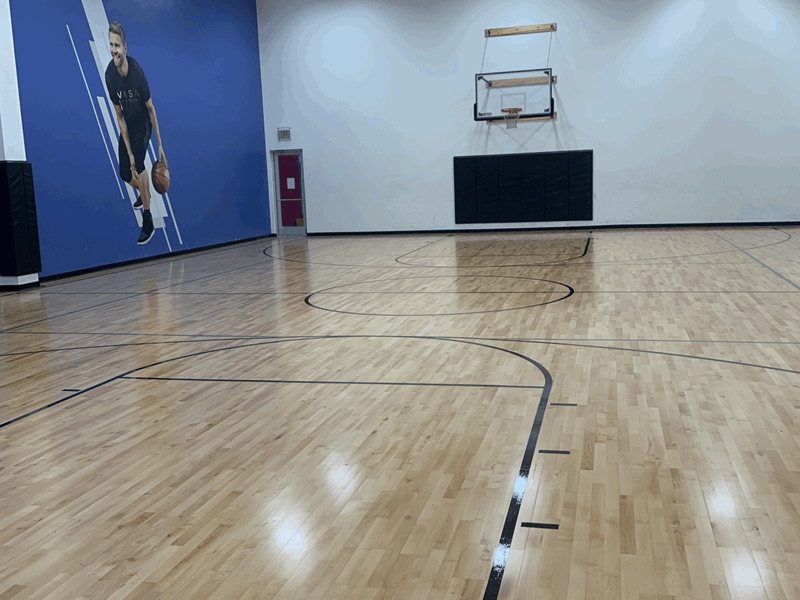
Squeaky floors are one of the most annoying and common problems in old basketball venues, and they are almost entirely preventable with proper design and precise installation techniques during the modular assembly process. Almost all floor squeaks are caused by two components rubbing against each other under pressure, so the entire modular system is engineered to eliminate every possible source of friction between moving parts. The first key anti-squeak measure is the full contact design between the keel and the rubber shock pad. Every keel is carefully adjusted with thin shims before it is secured, so the bottom surface of the keel presses completely and evenly against the top of the rubber pad, with no tiny gaps that could allow the keel to shift slightly when stepped on. The rubber pad’s high-friction textured bottom surface also grips tightly against the moisture barrier on the subfloor, preventing any horizontal sliding movement between the pad and the concrete.
Every screw used to fasten the base layer to the keels is driven at a controlled, consistent depth, so the screw head pulls the base board completely tight down against the top surface of the keel, with no tiny gap between the two surfaces. If even one screw is not driven all the way in, the base board can flex slightly when a player steps on it, creating a squeak as it rubs against the top of the keel. The same precision is used when fastening the top hardwood planks: every L-shaped steel nail is driven at exactly 45 degrees through the tongue of the plank, pulling the groove of the next plank down tight against the base layer, so there is no vertical movement possible between adjacent planks. No nails are driven straight down through the top surface of the planks, which would create a loose point that could squeak as the wood expands and contracts over time.
Another critical anti-squeak detail is the application of a thin layer of specialized low-friction wax on the tongue-and-groove joints of every hardwood plank before they are locked together. This wax fills in all the tiny microscopic gaps in the milled wood joint, so even if the planks shift slightly with seasonal humidity changes, the two smooth waxed surfaces slide past each other silently instead of rubbing together to create a high-pitched squeak. All the edges of the base layer boards are also lightly sanded before installation, so there are no sharp, rough wood edges that could rub against each other and make noise when the floor flexes under impact. When the entire installation is finished, every square meter of the court is walked on by the installation team to check for any squeaky spots before the paint is applied, so any small issues can be fixed immediately, ensuring the finished floor is completely silent even after decades of heavy use.
Leave a Reply