

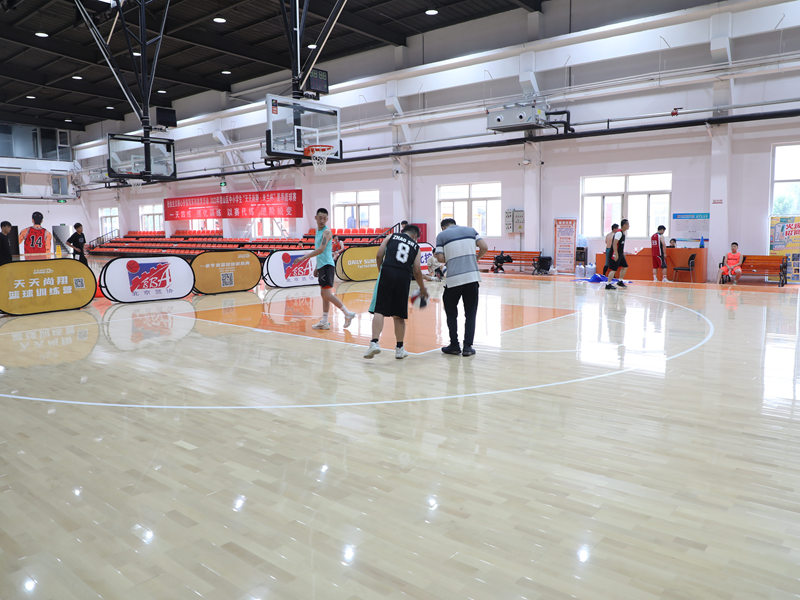
Every sports wood floor is ultimately judged on two things: how well it absorbs shock, and how well it returns the ball. These two metrics are the reason athletes choose wood over concrete, and the reason wood floors are mandated for competitive sports. Everything else, appearance, sound, feel, is secondary to these two performance factors.
Shock absorption refers to the floor's ability to reduce the impact force that travels through an athlete's body when they land. The standard measurement is expressed as a percentage. A floor with 45 percent shock absorption means it reduces the impact force by 45 percent compared to a hard surface like concrete. For basketball, the recommended range is 35 to 50 percent. For badminton, it is lower, around 20 to 35 percent, because too much cushion changes the shuttlecock's flight.
Shock absorption is primarily controlled by the elastic cushion layer in the structural system. A thicker or denser cushion absorbs more impact. But there is a limit. Too much cushion makes the floor feel spongy, which affects balance and agility. The right amount of cushion is sport-specific and must be calibrated during design.
Ball bounce is the other critical metric. It is measured as a percentage of the ball's original drop height. A ball dropped from 1800 millimeters should bounce back between 1200 and 1400 millimeters on a properly calibrated sports floor. If the bounce is too high, the ball is unpredictable. If it is too low, the game slows down and players tire faster.
Ball bounce is controlled by the panel thickness, the structural density, and the cushion layer. Thicker panels and denser grids produce a firmer bounce. Softer cushion layers reduce bounce. The combination must be tuned so that the bounce is consistent across the entire surface. A floor that bounces differently in one corner than in another is a failed floor, no matter how good it looks.
Both metrics are tested using standardized equipment and procedures. The results should be documented and available to the facility owner. If a supplier cannot provide test data for shock absorption and ball bounce, that is a red flag. These two numbers tell you everything you need to know about whether the floor will perform.
Leave a Reply