

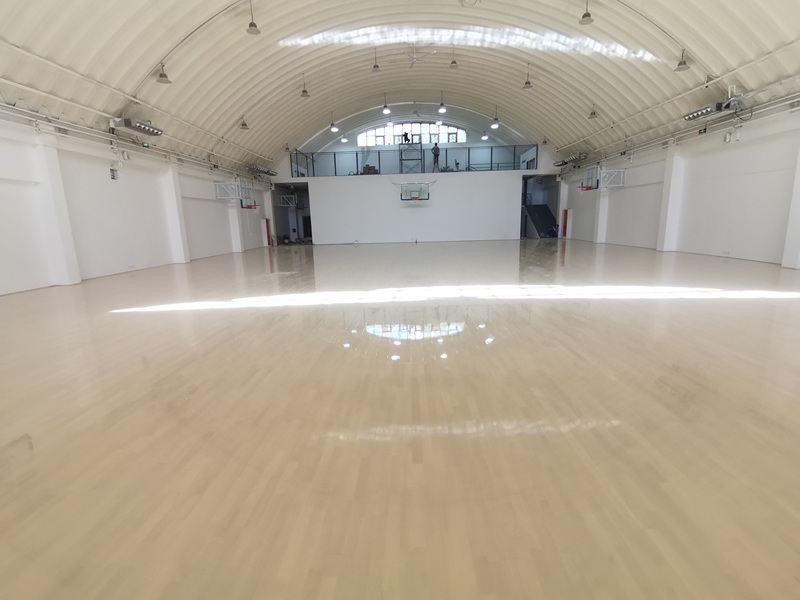
Achieving the perfect balance of slip resistance on sports wooden flooring is one of the most critical technical challenges in athletic surface design, and advanced printing technology has provided unprecedented control over this essential performance characteristic. The ideal sports floor must offer exactly the right amount of friction: enough grip to allow athletes to make sudden stops and sharp turns without slipping, but not so much traction that it restricts natural movement and causes strain on joints when feet need to slide slightly during play. For decades, facility managers struggled to maintain this delicate balance, as traditional wooden flooring would gradually become more slippery as the surface finish wore down, requiring constant maintenance to restore proper grip. Modern printing technology solves this problem by engineering the exact slip resistance characteristics directly into the surface structure of modular sports wooden flooring during the manufacturing process.
Printing technology allows manufacturers to create micro-scale surface topographies that are precisely calibrated to deliver the optimal coefficient of friction for athletic performance. By depositing printing materials in carefully controlled patterns at a microscopic level, engineers can create tiny, uniform peaks and valleys across the entire sports wooden flooring surface that interact with the soles of athletic footwear in exactly the desired way. These micro-textures are so small that they are almost invisible to the naked eye, but they create just the right amount of controlled friction that remains consistent across the entire playing surface. Unlike the random texture created by mechanical sanding, the printed micro-texture is perfectly uniform across every single modular panel, ensuring that there are no unexpected slippery spots or overly grippy areas that could catch an athlete off guard during competition.
The slip resistance created through printing technology on modular sports wooden flooring remains remarkably consistent over the entire lifetime of the floor. Because the micro-texture is integrated throughout the entire printed surface layer rather than being just a thin treatment on the very top, the texture characteristics do not change significantly as the floor experiences normal wear. Even after years of heavy use, the sports wooden flooring maintains its original carefully calibrated slip resistance, eliminating the dangerous situation where a floor that was once perfectly safe gradually becomes too slippery as its surface wears down. This consistent performance over time directly reduces the risk of athletic injuries related to unexpected changes in surface friction, creating a much safer playing environment for everyone who uses the facility.
Different sports have different optimal slip resistance requirements, and printing technology allows manufacturers to customize the surface characteristics of sports wooden flooring to match specific activities. A basketball court requires different friction characteristics than a dance studio, which in turn has different needs than a yoga facility. By adjusting the printed micro-texture pattern, the composition of the printing materials, and the density of material deposition, manufacturers can tune the surface performance to exactly match the requirements of each specific application. This level of customization was simply impossible before the advent of advanced printing technology, and it represents a major advancement in creating sports wooden flooring surfaces that are perfectly optimized for the specific activities that take place on them.
Leave a Reply