

Introduction
Basketball is played year-round in many parts of the world, and the playing surface can be either indoors or outdoors. While indoor courts almost always use hardwood flooring, outdoor courts present a unique set of challenges. In this article, we will compare indoor and outdoor basketball court surfaces, with a focus on hardwood flooring considerations for each environment.
Indoor Basketball Courts: The Hardwood Standard
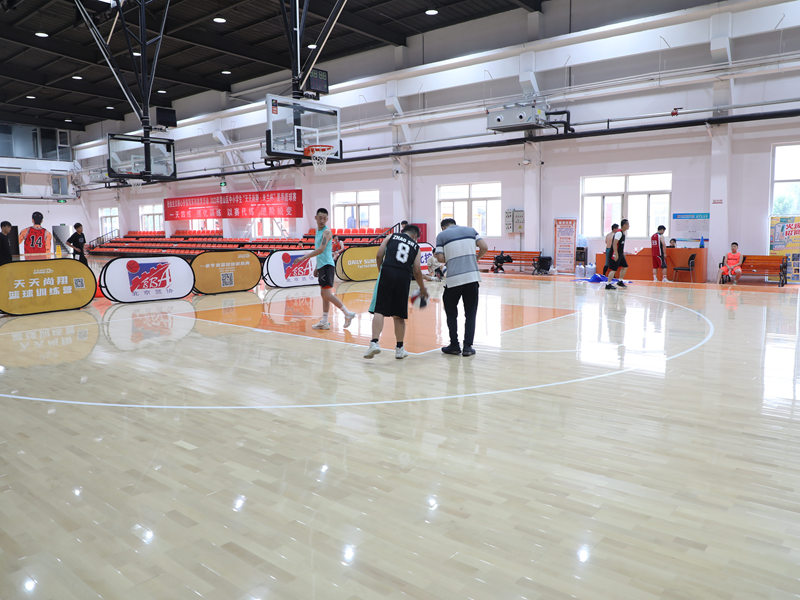
Indoor basketball courts are the norm for competitive play at every level, from high school to the NBA. The controlled environment allows hardwood flooring to perform at its best.
Advantages of Indoor Hardwood:
- Climate Control: Indoor arenas maintain temperature (68-72°F) and humidity (40-60%) year-round. This keeps the wood within its ideal moisture content range (6-9%), preventing expansion, contraction, and warping.
- Consistent Performance: With a stable environment, the ball bounce, traction, and shock absorption remain consistent throughout the year.
- Longer Lifespan: Indoor hardwood floors can last 20-30 years or more with proper maintenance, compared to 5-10 years for outdoor surfaces.
- Player Safety: Indoor hardwood provides the best combination of traction and shock absorption, reducing the risk of injuries.
Disadvantages of Indoor Hardwood:
- High Cost: As we discussed in our budget article, indoor hardwood courts are expensive to build and maintain.
- Limited Availability: Indoor courts are subject to scheduling conflicts and may not be available when you want to play.
- HVAC Costs: Maintaining the proper climate requires significant energy expenditure.
Outdoor Basketball Courts: Can You Use Hardwood?
The short answer is: technically yes, but it's not recommended for most situations. Here's why:
The Challenges of Outdoor Hardwood:
- Moisture: Outdoor hardwood is exposed to rain, snow, dew, and humidity fluctuations. Even with a high-quality finish, moisture will eventually penetrate the wood, causing swelling, warping, and rot.
- UV Exposure: Sunlight breaks down the lignin in wood, causing it to turn gray and become brittle. UV-resistant finishes can slow this process, but they cannot prevent it entirely.
- Temperature Extremes: Outdoor temperatures can range from below freezing to over 100°F. These extremes cause the wood to expand and contract dramatically, leading to gaps, buckling, and cupping.
- Maintenance: Outdoor hardwood requires constant maintenance — sealing, staining, and repairing — to keep it in playable condition. This can cost 2,000−5,000 per year.
When Outdoor Hardwood Makes Sense:
There are a few scenarios where outdoor hardwood is viable:
- Covered Outdoor Courts: If the court is under a permanent roof or canopy, it is essentially an indoor court and can use the same hardwood systems.
- Temporary Courts: For events or tournaments, temporary hardwood panels can be installed over a flat surface and removed afterward.
- High-End Residential Courts: Some homeowners install outdoor hardwood courts in covered patios or gazebos. These courts use marine-grade plywood and exotic hardwoods (like teak or ipe) that are more resistant to moisture.
Better Alternatives for Outdoor Courts:
| Surface | Cost per sq. ft. | Lifespan | Ball Response | Maintenance |
|---|---|---|---|---|
| Sport Court (Polypropylene Tiles) | 3−6 | 10-15 years | Good | Low |
| Poured-in-Place Rubber (EPDM) | 8−14 | 15-20 years | Good | Low |
| Acrylic Court Surface | 4−8 | 8-12 years | Very Good | Moderate |
| Concrete with Acrylic Coating | 3−5 | 10-15 years | Fair | Low |
| Outdoor Hardwood (Teak/Ipe) | 15−30 | 10-20 years | Excellent | High |
Sport Court Tiles: The Most Popular Outdoor Option
Sport Court is a modular tile system made from polypropylene. The tiles interlock to create a smooth, even surface that provides good ball response and traction. They are available in a variety of colors and can be installed over concrete or asphalt.
Advantages:
- Drainage holes allow water to pass through
- UV-resistant colors won't fade
- Easy to repair (replace individual tiles)
- Can be installed over existing surfaces
Disadvantages:
- Not as smooth as hardwood
- Ball response is slightly different
- Can become slippery when wet
The Hybrid Solution: Indoor-Outdoor Courts
Some modern facilities are building "indoor-outdoor" courts that use a retractable roof system. When the roof is closed, the court is an indoor hardwood court. When the roof is open, the court is exposed to the elements, but the hardwood is protected by a high-performance finish and a drainage system.
These courts are expensive (500,000−2,000,000+) but offer the best of both worlds.
Conclusion
For competitive basketball, indoor hardwood is the only real option. The controlled environment, consistent performance, and player safety benefits far outweigh the cost. For recreational outdoor play, Sport Court tiles or poured-in-place rubber are more practical and cost-effective. If you are determined to have outdoor hardwood, make sure the court is covered and use marine-grade materials. No matter what surface you choose, the most important thing is to play the game and have fun.
Leave a Reply