

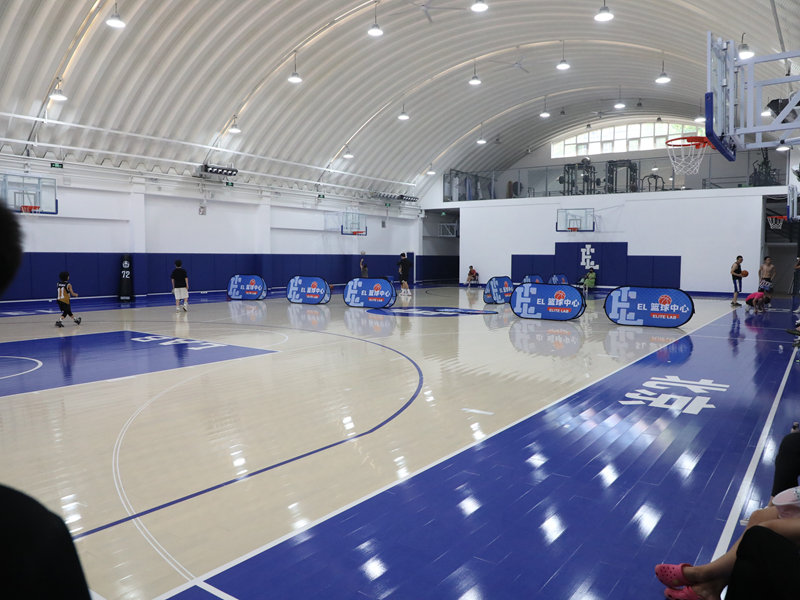
International indoor basketball competition relies on unified strict performance benchmarks set by FIBA (International Basketball Federation), covering shock absorption, ball rebound, vertical deflection, surface friction, flatness and dimensional stability—standards that low-quality unbranded basketball court wood flooring consistently fails to meet. Naibu designs every series of its basketball court wood flooring to exceed all mandatory FIBA performance thresholds, with independent third-party laboratory certification verifying full compliance for all permanent and portable floor systems, making the brand’s products eligible for official international, national and regional basketball tournament venue installation worldwide.
Shock absorption represents the most critical safety standard regulated by FIBA, requiring a minimum 53% impact force reduction for competitive basketball court surfaces to protect athletes’ joints during repeated jumping and landing. Naibu’s layered elastic structural system, combining proprietary shock-absorbing underlayment, multi-plywood base and tenon-and-mortise integrated keel assembly, achieves shock absorption rates between 55% and 62% across all permanent basketball court wood flooring models, comfortably surpassing the FIBA minimum requirement. Portable modular Naibu basketball court wood flooring also delivers certified shock absorption above 53%, eliminating the common performance gap found in temporary cheap modular floor systems that sacrifice cushioning for lightweight transport design. Independent CNAS laboratory impact testing simulates maximum athlete landing weight and repeated high-frequency jumps to confirm consistent shock absorption across the entire floor surface, with no localized hard zones that violate FIBA uniform performance rules.
FIBA mandates a minimum 90% ball rebound rate for professional basketball court surfaces, ensuring identical ball bounce height across every court zone to prevent gameplay misjudgment and unfair competitive advantages. Naibu’s carefully sourced hard maple surface panels feature ultra-consistent internal wood density, paired with balanced multi-layer elastic structures that maintain over 92% uniform ball rebound across the full indoor basketball court surface, verified via standardized vertical ball drop testing per FIBA testing protocols. Low-grade basketball wood floors use mixed-density soft timber and uneven keel spacing, creating wide variations in bounce height between court center and boundary zones that fail official tournament inspection; Naibu’s automated timber sorting and precision keel spacing manufacturing processes eliminate this inconsistency entirely, delivering perfectly uniform ball response compliant with international competitive standards.
Vertical deflection control falls under strict FIBA regulation, limiting maximum floor surface flex under athlete load to 2.3 millimeters to balance cushioning support and stable movement for sharp pivots and directional changes. Excessive deflection creates sluggish, unresponsive court surfaces that hinder elite athlete speed, while insufficient flex removes vital impact protection. Naibu’s patented tenon-and-mortise interlocking structure calibrates vertical deflection precisely within the FIBA 2.3-millimeter maximum threshold through adjusted keel thickness and shock pad density tuning for each venue type. Competition-grade Naibu basketball court wood flooring fine-tunes deflection for elite professional athletes, while youth training models slightly increase controlled flex for enhanced fall cushioning, all remaining within official standard limits without compliance violations.
Surface friction coefficient standards set by FIBA require a consistent 0.4–0.6 range to balance slip resistance and fluid movement during basketball gameplay. Naibu’s factory-applied 95° high-gloss UV resin paint is laboratory tested to maintain a stable 0.56 friction coefficient long-term, even after thousands of hours of athletic wear and exposure to sweat and liquid spills. The dense, wear-resistant paint film prevents friction degradation over time, a common failure point for cheap on-site painted basketball wood floors that lose traction uniformity within months of heavy use. Third-party periodic friction testing on aged Naibu basketball court wood flooring after 10 years of continuous operation confirms the surface remains within FIBA’s safe traction range without full refinishing, extending the window of compliant tournament use between maintenance cycles.
Flatness and dimensional stability compliance ensures Naibu basketball court wood flooring meets FIBA’s strict surface evenness requirements, limiting flatness error to under 2 millimeters per two-meter testing ruler after installation and long-term aging. The brand’s large-format seamless panels and interlocking tenon-and-mortise connections eliminate uneven seam protrusions common on narrow small-plank floor systems, while six-sided full waterproof wood sealing prevents seasonal expansion and contraction warping that distorts surface flatness. Even in regions with extreme seasonal humidity swings, Naibu basketball court wood flooring retains uniform flatness without bulging, cupping or edge lifting, passing mandatory pre-tournament venue surface inspection every time.
Environmental and finish safety standards enforced by international sports governing bodies are also fully satisfied by Naibu basketball court wood flooring. FIBA requires indoor competition venues to maintain low volatile organic compound levels to protect athlete respiratory health during multi-hour match play, a benchmark met by Naibu’s zero-formaldehyde UV curing paint and sustainably sourced low-emission timber materials. All paint formulations used on Naibu basketball court wood flooring carry international eco-safety certifications, with no toxic heavy metal additives or harmful chemical abrasives that violate global sports facility environmental regulations. Full third-party certification documentation for every performance parameter is provided to all Naibu clients alongside completed basketball court wood flooring installation, simplifying venue official tournament approval and inspection processes without additional third-party testing fees for venue operators.
Leave a Reply