

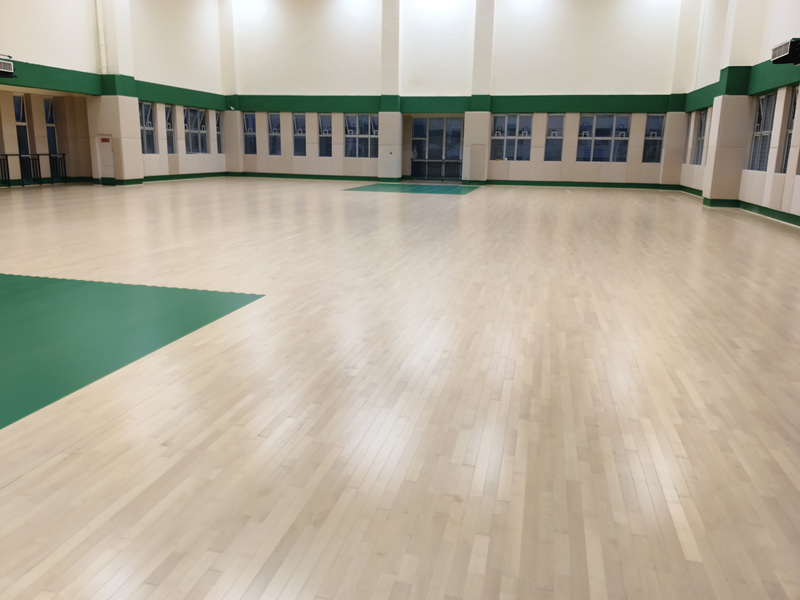
The hidden expansion gap around the perimeter of a modular indoor basketball court wood floor is one of the most important, yet most often overlooked, details of the entire installation process. This 20-millimeter wide gap between the edge of the hardwood planks and the surrounding wall is not a flaw or a mistake, it is a carefully calculated design feature that gives the entire floor system room to move as the natural wood expands and contracts with seasonal changes in humidity. Without this gap, when the wood absorbs moisture during a humid summer, it would have nowhere to expand, so the internal pressure would build up until the planks buckle upward in the middle of the court, creating dangerous raised spots that players can trip over.
This perimeter gap is never left open and exposed. It is completely covered by a specialized vented wooden skirting board, which is fastened to the wall rather than to the floor, so the floor can move freely underneath it without hitting any hard obstacles. The skirting board is drilled with dozens of small, evenly spaced ventilation holes along its entire length, which connect directly to the hidden air circulation channels running along the keels under the floor. This creates a continuous, slow flow of fresh air that circulates under the entire floor system, preventing moist, stagnant air from being trapped against the bottom of the hardwood planks, which would otherwise cause mold growth and wood rot. The skirting board also hides the ugly, uneven raw edge of the floor planks where they meet the wall, creating a clean, finished professional look for the entire venue.
For venues that have permanent fixed structures like basketball hoop support poles or court entry doors located inside the playing area, small local expansion gaps are also left around the base of every pole and every door frame. These gaps are hidden with flexible, durable PVC trim that moves slightly with the floor, so there are no unsightly cracks or gaps visible around these structures. All of these perimeter gaps are calculated based on the total area of the court: the larger the total floor area, the wider the required expansion gap, to accommodate the total amount of movement from hundreds of square meters of expanding wood. Even for a full-size 420-square-meter official competition court, this carefully designed gap system ensures the floor will never buckle, warp, or push against the walls, even in the most humid summer weather.
Leave a Reply