

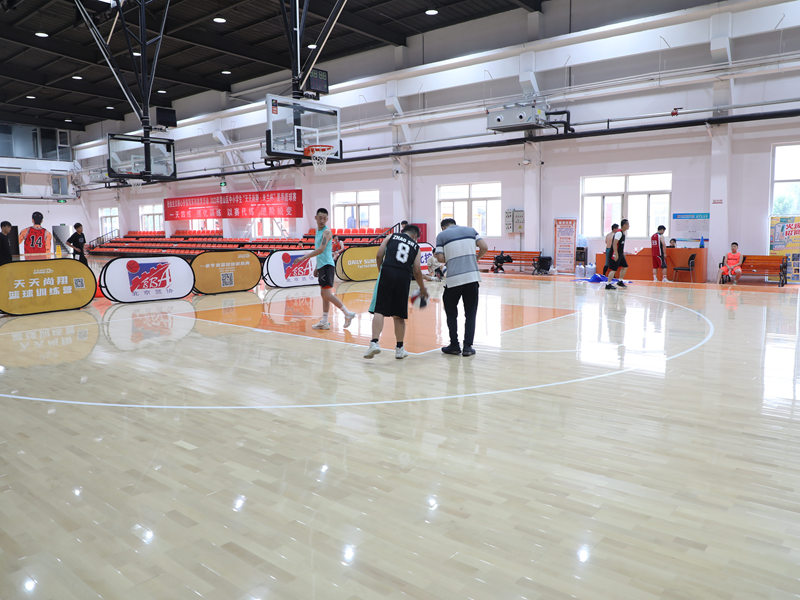
When facility managers are choosing a new playing surface, they often find themselves weighing the pros and cons of indoor basketball court wood flooring against the many synthetic sports flooring options that are available on the market today. Synthetic surfaces, which are usually made from layers of rubber, vinyl, or polyurethane, often have a lower upfront cost, which can make them seem appealing for facilities working with tight budgets. However, when you look at the full lifecycle costs and performance characteristics, wood flooring offers a number of significant advantages that make it the preferred choice for almost all high-level basketball programs. The most important difference is the way that wood interacts with the human body during play, offering a natural, responsive feel that even the most advanced synthetic surfaces have never been able to fully replicate.
One of the biggest practical differences between indoor basketball court wood flooring and synthetic surfaces is how they perform over thousands of hours of heavy use. Synthetic surfaces tend to develop permanent "dead spots" over time, where the cushioning layer has been compressed down completely from repeated impact, leaving those areas with no shock absorption at all. These dead spots are impossible to repair without replacing the entire section of the surface, and they create inconsistent playing conditions that increase injury risk. Wood flooring, by contrast, maintains its consistent shock absorption properties for decades, because the natural resilience of the wood fibers and the subfloor system never permanently compresses, no matter how many times players jump and land on it. The entire surface maintains uniform performance across every square foot for the entire lifespan of the floor.
Another key advantage of indoor basketball court wood flooring is its superior traction characteristics when properly maintained. Synthetic surfaces can become dangerously slippery when even a small amount of moisture from sweat or spilled drinks gets on them, creating a major fall hazard for players. Wood flooring, by comparison, maintains consistent, reliable traction even when slightly damp, as long as the finish is in good condition. Wood also does not trap heat the way many dark synthetic surfaces do, keeping the court at a more comfortable temperature during intense games where players are generating a lot of body heat. Over the 50+ year lifespan of a wood floor, its total cost of ownership ends up being far lower than synthetic surfaces, which need to be replaced multiple times over that same period.
Leave a Reply