

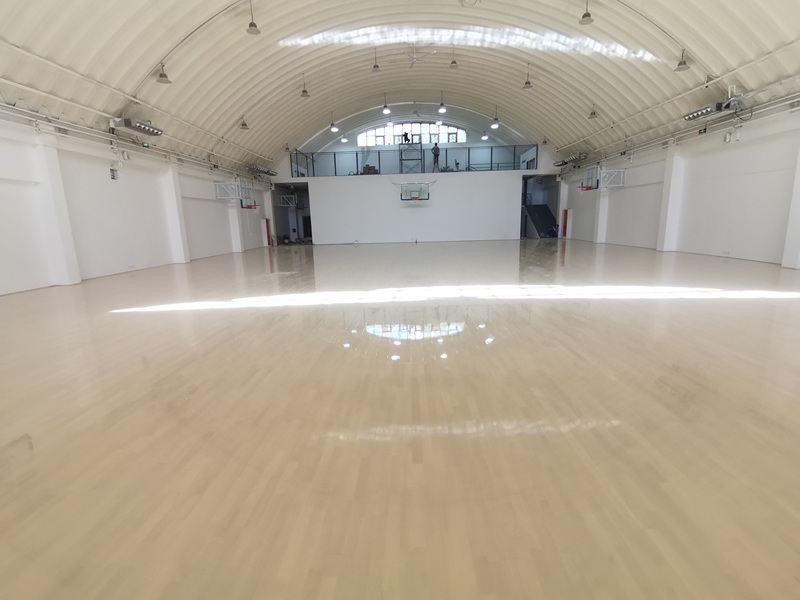
Basketball wooden floors are not just a beautiful playing surface; they are also a marvel of engineering and design. The science behind these floors involves a deep understanding of materials science, structural engineering, and biomechanics, all of which come together to create a safe, high-performance playing environment for athletes.
One of the key engineering principles behind basketball wooden floors is shock absorption. The multi-layered construction of these floors, including a subfloor, mid-layer, and top layer of hardwood, is designed to distribute impact forces evenly across the surface, reducing the stress on players' joints and muscles. This shock absorption is achieved through the use of materials with different elastic properties, such as foam or rubber pads in the mid-layer, which compress and rebound to absorb and dissipate energy.
Another important engineering principle is traction. The smooth, even surface of hardwood, combined with the right finish, provides excellent grip for players' shoes, reducing the risk of slips and falls. This traction is achieved through careful selection of the wood species and finish, as well as the design of the court markings, which are strategically placed to enhance grip and stability during gameplay.
Ball bounce is also a critical aspect of basketball wooden floor engineering. The hard, smooth surface of hardwood ensures that the ball bounces predictably and evenly, allowing players to anticipate and react to the ball's movement. This consistency is achieved through the use of high-quality wood with uniform density and stiffness, as well as precise manufacturing processes that ensure the floor is level and free of imperfections.
Finally, the structural integrity of basketball wooden floors is essential for ensuring their longevity and safety. The subfloor and mid-layer must be designed to provide a stable base for the top layer of hardwood, while also allowing for some flexibility to accommodate movement and expansion of the wood. Additionally, the floor must be properly anchored to the underlying structure to prevent shifting or movement during gameplay.
The science behind basketball wooden floors is a complex and fascinating field that combines materials science, structural engineering, and biomechanics. By understanding these engineering principles, we can appreciate the incredible technology and design that goes into creating a safe, high-performance playing environment for athletes.
Leave a Reply